(Lost Recordings)李希特 拉赫曼尼諾夫:13首前奏曲 舒伯特:三首鋼琴曲SVIATOSLAV RICHTER LIVE IN EAST GERMANY VOL. I(透明膠2LP)
商品介紹
SAPPHIRE EDITION®
SVIATOSLAV RICHTER
LIVE IN EAST GERMANY VOL. I
Sapphire edition® - Limited to 500 copies
Record 1
Sergei Rachmaninov: 13 Preludes
side A
I.Prelude in F-sharp minor No. 1, Op. 23
II.Prelude in A major No. 9, Op. 32
III.Prelude in B minor No. 10, Op. 32
IV.Prelude in G-sharp minor No. 12, Op. 32
V.Prelude in A-flat major No. 8, Op. 23
VI.Prelude in C major No. 1, Op. 32
VII.Prelude in B-flat minor No. 2, Op. 32
side B
VIII.Prelude in F minor No. 6, Op. 32
IX.Prelude in F major No. 7, Op. 32
X.Prelude in B-flat major No. 2, Op. 23
XI.Prelude in D major No. 4, Op. 23
XII.VPrelude in G minor No. 5, Op. 23
XIII.Prelude in C minor No. 7, Op. 23
Record 2*
Franz Schubert: 3 Klavierstücke, D946
side C
I.No. 1 in E-Flat minor: Allegro assai
side D
II.No. 12 in E-flat major: Allegretto
III.No. 3 in C major: Allegro
500 Copies
Sapphire Edition® pushes the boundaries of audio media.
It represents the culmination of our latest innovations in restoration and manufacturing processes — without any constraints or compromises — thus offering an unparalleled musical experience.
The Eagle
Sviatoslav Richter was always a man apart. At no moment in his life would he follow in the footsteps of others, be they musicians, writers or political figures. Until the age of fifteen he was content to work at his piano in Odessa, alone. Self-taught. He was expected to become a painter instead, though no one paid him much heed—tossed about, in the middle of the civil war, between parents leading rather dissolute lives and his aunt Tamara. He developed a passion for opera and became an outstanding accompanist at the Odessa Opera and for several ballet companies. How did he come to stand, in 1937, at twenty-two, before Heinrich Neuhaus, that towering professor of the Moscow Conservatory? No one knows. History records only that, during Richter’s audition, the master is said to have whispered to the man beside him: “In my opinion, this is a musician of genius.” It changed nothing in his character. To the end of his life he remained an utterly free figure, almost an enigma: “Life unfolds for me like a theater presenting a succession of somewhat unreal feelings, whereas the elements of art strike me as reality and go straight to my heart.” Truth and legend intertwine: expelled twice from the conservatory for refusing “political” obedience, “forgetting” to begin a tour of the United States, thousands of miles driven along the roads of Europe with his piano following behind, verbal skirmishes with Karajan, whole weeks spent secluded in his dacha with his instrument for sole companion…
As Bruno Monsaingeon writes in the text accompanying his film Richter: The Enigma: “He fears nothing and offers no hold on himself; that will be his great strength. Allergic to any kind of planning, he plays where and when he pleases.” Richter expects nothing and aspires to nothing beyond serving the music. His discipline verges on the obsessive: he would count the hours spent at the piano in order to make up, the following day, for any he had missed. He confessed time and again: “I am a mirror.” For him the performer is no more than an executant: “He must not dominate the music but dissolve into it.”
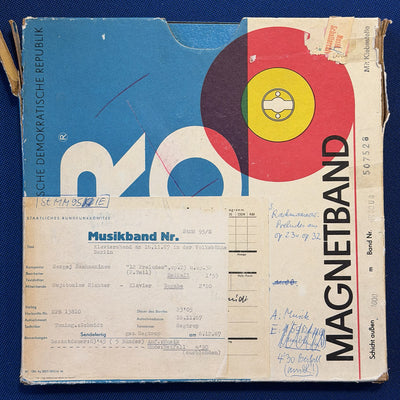
The Lost Recordings brings to light, for the first time, recordings that are exceptional on more than one count. In the archives of East German radio we discovered the analog tapes of two previously unreleased concerts.
In the mid-1960s, Sviatoslav Richter was fifty years old and had only recently begun to appear on every stage in the world. His playing was probably at its peak, in power as much as in delicacy. And with two composers who hold a particular place within his immense repertoire: Sergei Rachmaninoff and Franz Schubert.
At the close of these two concerts, the final word must go to the man who knew how to single Richter out from all others: his teacher, Heinrich Neuhaus. More aware than anyone of his student’s prodigious gift, he wrote of him words whose aptness still illuminates: “His singular capacity to grasp the whole while losing nothing of the smallest details of a composition suggests a comparison with an eagle who, from his great height, can see as far as the horizon and yet make out the least detail of the landscape.”
Sviatoslav Richter, piano
Recorded November 16, 1967, Volksbühne, Berlin, East Germany
*July 15, 1964, Nationaltheater, Weimar, East Germany
STEREO ℗ 1967 DRA, *MONO ℗ 1964 DRA
Restored by © 2026 THE LOST RECORDINGS from the original analog tapes
Ref.: TLR-2603070VS
33rpm Lacquer-cuts: Marie Pieprzownik
200g Double Ultimate Record®
Limited edition: 500 copies
Photos: © Ullstein Bild, © 1964 Jochen Blume, © 1966 Alexander Saakov
Tip-on Gatefold printed in Italy
Deluxe Boxset
Phoenix Pressings
*A 16-bit album download card is included with the vinyl.
ULTIMATE RECORD®
New Master
Achieved with our latest equipment and expertise
200g Ultimate Record®
Greater record inertia eliminates unwanted resonances
New cuts by Kevin Gray
The world's finest specialist
New Electroplating
New mirror-polished stamper. Each presses no more than 500 copies
New 100% virgin Ultra-clear compound
Ensures the highest possible purity
New pressing cycle
Allows perfect record flatness
Absolute quality control
Each copy is carefully selected and guaranteed pristine
SVIATOSLAV RICHTER
Live in East Germany Vol. I
The history of this discovery
"For decades, German radio stations would not play vinyl records directly on the air: they first made a tape copy, so as to avoid any risk during broadcast. Seventy years later, they find it difficult to tell the sometimes priceless recordings they made themselves from the vinyl copies intended for promotional airplay.
A doubt of another kind also lingered: the running times listed in their database seemed inconsistent. Were these merely excerpts, or complete works?
It was in January 2026 — thanks to the tenacity of Michel Navarra and Ulf Drechsel, and after more than two years of effort — that we finally listened to the first original tapes from the archives of the former East Germany, not far from Berlin. Our fears were laid to rest. Among the 80 tapes selected are the names of David Oistrakh, Evgeny Mravinsky, Leonid Kogan and Sviatoslav Richter. We are proud to present here the first volume of previously unreleased recordings devoted to a true legend of the piano, Sviatoslav Richter."
Frédéric D'ORIA-NICOLAS
Musical treasure seeker
相關商品


