(The Lost Recordings)卡欽:布拉姆斯10首鋼琴獨奏匈牙利舞曲、孟德爾頌第1號前奏曲與賦格、奇想迴旋曲、李斯特第12號匈牙利狂想曲JULIUS KATCHEN THE UNRELEASED STUDIO RECORDINGS(45轉2LP)
商品介紹
side A
Brahms: Ten Hungarian Dances for piano solo
1.No. 1 in G Minor - Allegro molto
2.No. 2 in D Minor - Allegro non assai
3.No. 3 in F Major - Allegretto
4.No. 4 in F-Sharp Minor - Pocco sostenuto
side B
5.No. 5 in F-Sharp Minor - Allegro
6.No. 6 in D-Flat Major - Vivace
7.No. 7 in F Major - Allegretto
8.No. 8 in A Minor - Presto
9.No. 9 in E Minor - Allegro non troppo
10No. 10 in E Major - Presto
side C
Mendelssohn
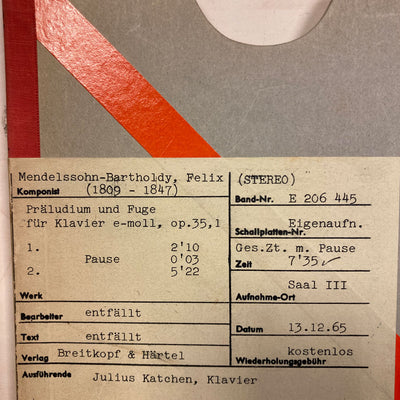
1.Prelude and Fugue in E Minor, Op. 35, No. 1
2.Mendelssohn: Rondo capriccioso, Op. 14*
side C
3.Liszt: Hungarian Rhapsody No. 12 in C-Sharp Minor, S. 244*
3000 Copies
Julius Katchen’s reputation for his interpretation of the work of Johannes Brahms is universally acknowledged. On 13 December 1965, in the German radio station’s renowned Studio 3, Katchen sat down at the piano to play a version of ten of Brahms’ Hungarian Dances for Solo Piano, until today never published.
Of course, his repertoire extends beyond the works of Brahms. As this edition of concerts for Berlin Radio attests, he approaches both Mendelssohn and Liszt with equal power.
Brahms’s Hungarian Dances comprise a series of twenty-one compositions and arrangements, written between 1867 and 1880 and inspired by popular Roma and Slav folk tunes. The first
series of ten dances for piano solo displays the fervor of the composer in his youth; Katchen clearly perceives their great vivacity. Katchen is no mere performer of Brahms among many. He truly lives the music, as if he were the composer’s close friend, his confidant. The dances take the form of a bucolic painting that Brahms and Katchen paint together – a painting filled with joy, despair, unruliness, fear and tenderness.
The first of Felix Mendelssohn’s Six Preludes and Fugues, Opus 35, reveals a different vision of German romanticism. With greater austerity, heightened spirituality, it is inspired by the baroque form of chorale and fugue to which Johann Sebastian Bach brought such dignity. Mendelssohn had rediscovered Bach’s music, fallen into oblivion.
Mendelssohn completed the Rondo Capriccioso in 1830 after reworking it several times over the course of two years to finally offer it to pianist Delphine von Schauroth, whom he had been courting perseveringly, but ultimately, unsuccessfully. Perhaps this is why the andante conveys overtones of despair that contrast with the inordinate gaiety of the Presto.
With the works of Franz Liszt, who all his life had soaked up the sounds and melodies of his native Hungary, we return to folklore. Katchen gives a majestic rendition of the Twelfth Rhapsody with a delectable version, playing on a musical palette that includes, in turn, melancholy, pianistic virtuosity, grave themes and wild dances.
In barely more than twenty years of a musical career, Julius Katchen proved that he had unique artistic talents. But the life of this prodigy was cut short too early. This edition attests to his dazzling trajectory at the piano as an interpreter of the romantic tradition.
Julius Katchen, piano
Registered on 13 December 1965, *8 January 1960, Room 3, RBB, Berlin, Germany
STEREO ℗ 1965, MONO ℗ 1960 RBB
Restored by © 2026 THE LOST RECORDINGS from the original analog tapes
Ref.: TLR-2503066V
45rpm engraving: Kevin Gray
New tip-on pouch printed in Italy
Double Vinyl Album 180g
Phoenix Pressings
*A download card for the 16-bit album is included with the vinyl.
AN UNEQUALLED KNOW-HOW
- Phoenix Mastering™ restoration from original analog tapes
- Lacquer-Cuts by Kevin Gray
- 180g test-pressings approving in our studios
- New Stampers every 500 copies
- Slow pressing cycle
- Unequalled quality control in Europe
- New Tip-on gatefold printed in Italy
JULIUS KATCHEN
THE UNRELEASED STUDIO RECORDINGS
The History of this discovery
"It was during one of our trips to the Berlin Radio archives that we discovered original recordings by the pianist Julius Katchen. While the Hungarian Dances are extremely popular, the solo piano version, which Brahms himself arranged and which is incredibly virtuosic, is very rarely performed. This fabulous studio version was recorded with Mendelssohn's Prelude and Fugue. These previously unreleased recordings date from 1965 and were captured in stereo! Almost five years earlier, Katchen had already made the piano in Berlin Radio's Room 3 sing and roar with another Mendelssohn piece—the Rondo Capriccioso—and Liszt's famous 12th Rhapsody. The length of the works and the magnificent sound recordings led us to record this moment in history on 45 rpm records as a tribute to one of the greatest interpreters of Brahms's music, tragically taken by illness." at only 43 years old."
Frédéric D'ORIA-NICOLAS
Musical treasure hunter
相關商品


